The 1980s were a bold, neon-charged decade defined by pop culture explosions, technological breakthroughs, economic shifts, and a larger-than-life attitude that reshaped music, fashion, movies, and everyday life.
I was in Middle School, High School and College during the eighties. I still LOVE the movies, music, TV shows and video games of the eighties. My kids say I am still stuck in the eighties. I take that as a compliment. They have seen all my favorite 80s movies (most they liked) and still watch 80s TV re-runs with me. They are mixed on the music, but every new generation is. My kids do love playing 80s arcade games (especially Galaga). The historical, sporting and cultural events of the 80s are still talked about these days; so much happened to reshape our world in a better way during that one decade. I enjoyed reliving the 80s while putting this web site together. I hope you enjoy taking a step back and reliving the 1980s while viewing the different sections of the web site. It is a evolving project and I will be continually be adding new content to growingupintheeighties.com as time permits. It is a passion of mine. David

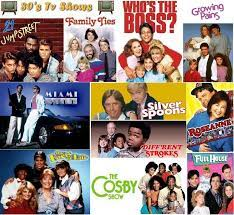
Television was transformed in the 1980s. With the advent of cable, the three major networks — ABC, CBS and NBC — lost their monopoly on what Americans viewed in their living rooms. In the late Seventies, Time Inc.’s Home Box Office became available. In 1980, Ted Turner unveiled the Cable News Network (CNN). Media baron Rupert Murdoch paid a billion dollars for Twentieth Century Fox and, with Barry Diller, created TV’s fourth network, Fox.
The decade was the golden age for primetime soap operas — Dallas, Dynasty, Falcon Crest, and Knots Landing all had their legions of faithful viewers. New life was breathed into the sitcom, with hit series like The Cosby Show, Cheers, Family Ties and the irreverent Married. . .With Children.The animated sitcom The Simpsons debuted in 1989, though Bart Simpson had previously made appearances on Fox’s The Tracey Ullman Show. Top crime dramas like Magnum P.I. and Hill Street Blues enjoyed long runs in the 80s, while the innovative Miami Vice had a significant impact on television imagery. Programs like thirtysomething and Moonlighting appealed to the yuppie crowd. TV talk shows hosted by the likes of Geraldo Rivera and David Letterman became more provocative and occasionally outrageous.
A group of young stars who became known as The Brat Pack dominated the youth-oriented films of the decade. Many of them joined the ensemble cast of St. Elmo’s Fire (1985); they included Andrew McCarthy, Rob Lowe, Emilio Estevez, Ally Sheedy, Demi Moore and Judd Nelson. There were others — Molly Ringwald, Matt Dillon, Charlie Sheen, Anthony Michael Hall, Sean Penn and Robert Downey, Jr.
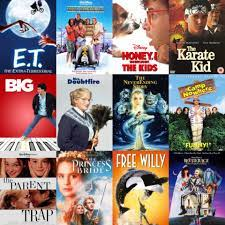
The Eighties was the decade of the sequel, and in some cases the sequel was as good as (or even better than) — and as commercially successful — as the original. Harrison Ford’s Indiana Jones became an American icon in Raiders of the Lost Ark (1981), Indiana Jones and the Temple of Doom (1984), and Indiana Jones and the Last Crusade (1989). Comic Eddie Murphy became a big star of the big screen with Beverly Hills Cop (1984) and Beverly Hills Cop II (1987). Lethal Weapon(1987) and Die Hard (1988) defined the action flick, and both spawned hit sequels. Sylvester Stallone’s Rambo flexed America’s muscles and represented the nation’s renewed patriotic fervor inFirst Blood (1982), Rambo: First Blood, Part II (1985) and Rambo III (1988).
The 1980s saw the emergence of pop, dance music, RAP and new wave. Rock music continued to enjoy a wide audience. Sub-genres such as new wave, soft rock, and glam metal and shred guitar characterized by heavy distortion, pinch harmonics and whammy bar abuse became very popular. For the early part of the 80s, RAP made a large impression on the Billboard R&B charts, but failed to break into the mainstream, but by the second part of the 80’s, many RAP artists and their songs became very popular. The 1980s are commonly remembered for an increase in the use of digital recording, associated with the usage of synthesizers, with synthpop music and other electronic genres featuring non-traditional instruments increasing in popularity.
The 1980s saw the reinvention of Michael Jackson, the superstardom of Prince and the emergence of Madonna, Whitney Houston, and Janet Jackson—who were all the most successful musicians during this time.
The 1980s was a decade of revolutionary changes on the music scene. The two major developments were the advent of MTV and the compact disc.
The Golden Era of Video Games was a time of great technical breakthroughs and game design creativity in arcade games. Video arcade games were designed in a wide variety of genres, while game developers had to work within strict limits of available processor power and memory. This era also saw the rapid spread of video arcades and gamerooms across North America, Europe and Japan. At the same time, video games started to appear in supermarkets, restaurants, bars, pubs, liquor stores, gas stations, bowling alleys storefronts and many other retail establishments looking for extra income and customer traffic.Very popular video arcade games would more than on occasion cause a crush of teenagers at arcades, eager to try the latest in public entertainment.
The two most successful arcade game companies of this era were Namco (the Japanese company that created Pac-Man, Pole Position, and Dig Dug) and Atari (the US-based firm that first introduced video games into arcades). These two companies wrestled for the top slot in American video arcades for several years. Other prominent arcade companies such as Sega, Nintendo, Capcom, Konami, Taito, Williams, Bally / Midway Manufacturing Company, Cinematronics and SNK were among many others also played major roles in the early development of the video arcade game industry.
The arcade game industry truly entered its “Golden Age” in the late 70’s and early 80’s,with consumer awareness and market penetration of video arcade machines in bars, pubs, malls, storefronts and restaurants rising rapidly with introductions of such classic video arcade machines like Asteroids, Space Invaders, Galaxian, Donkey Kong, and the timeless video arcade classic game, Pac-Man.
I am a child of the eighties. That is what I prefer to be called. The nineties can do without me. Grunge isn’t here to stay, fashion is fickle and “Generation X” is a myth created by some over-40 writer trying to figure out why people wear flannel in the summer. When I got home from school, I played with my Atari 2600. I got up on Saturday mornings at 6 a.m. to watch bad Hanna-Barbera cartoons. Ronald Reagan was cool. I drank Dr. Pepper. “I’m a Pepper, you’re a Pepper, wouldn’t you like to be a Pepper, too?” The world stopped when the Challenger exploded. We are children of the eighties. That is what I prefer “they” call it.
Ultimate 80s Party Ideas
How to Throw the Ultimate Totally Rad Retro Celebration An 80s party is more than just a theme—it’s a full-blown celebration of excess, color, music, and unforgettable pop culture. The 1980s were defined by bold fashion, iconic movies, groundbreaking music, and neon-soaked fun, making the decade perfect inspiration for a high-energy party. Whether you’re hosting … Continue reading
80s Party Planning & Inspiration
- fun 80s party ideas
- unique 80s party ideas
- creative 80s party themes
- best 80s party ideas
- classic 80s party ideas
80s Costumes & Dress-Up
- 80s party costume ideas
- 80s party outfits
- 80s dress up party ideas
- 80s costume party ideas
- what to wear to an 80s party
Remembering the 1980s
The 80s introduced a wave of exciting entertainment and innovation. Arcades were social hubs, packed with glowing machines and the sounds of games like Pac-Man and Donkey Kong. At home, the arrival of systems like the Nintendo Entertainment System transformed living rooms into gaming zones. Saturday mornings were sacred, filled with cartoons and sugary cereal, while afternoons often meant reruns, sitcoms, or after-school specials.
Music was everywhere and deeply influential. The launch of MTV changed how people experienced songs, turning artists like Michael Jackson, Madonna, and Prince into global icons not just for their sound, but their style and videos. Cassette tapes and boom boxes made music portable, and making a mixtape was a personal art form.
Movies were larger-than-life and endlessly quotable, with hits like E.T. the Extra-Terrestrial, Back to the Future, and The Breakfast Club capturing the imagination of a generation. These films weren’t just entertainment—they became shared cultural touchstones.
Fashion was bold, expressive, and sometimes outrageous. Think neon colors, leg warmers, acid-wash jeans, and big hair. Trends were heavily influenced by music videos, movies, and celebrities, and self-expression often meant standing out rather than fitting in.
Technology was just beginning to enter everyday life. Families gathered around a single TV, used rotary or push-button phones, and recorded shows on VHS tapes. Early home computers like the Apple II and Commodore 64 introduced kids to programming and gaming, planting the seeds for the digital world we live in today.
At its core, growing up in the 80s was about balance—between freedom and structure, simplicity and innovation. It was a time when connections were face-to-face, entertainment required a bit more effort, and the memories made often feel a little more tangible and shared.